My Research Vision
My research’s overarching mission is to develop an intricate understanding of how cancer cell-intrinsic and -extrinsic mechanisms regulate intercellular crosstalk within the tumor and beyond (e.g. metastasis), and thereafter, develop targeted therapeutics that manipulate intercellular crosstalk to elicit high-avidity anti-tumor responses in untreatable or difficult-to-treat malignancies. My extensive experience in intercellular crosstalk regulation at the cell and molecular level, development of novel RNA-based targeted cancer therapeutics, and expertise in bioinformatics forms the foundation of my research vision.
Background
During development and homeostasis, the human body relies on coordinated cell-to-cell communication across tissues and organs. In pathological states like cancer, tumor cells participate in this crosstalk, leading to selection pressures, clonal evolution, and tumor heterogeneity. Ultimately, tumors that emerge gain advantages that are either tumor-intrinsic or tumor-extrinsic. Tumor-intrinsic advantages, like sustained proliferation and immune evasion, directly influence cancer cell survival. Tumor-extrinsic advantages, such as immune suppression and angiogenesis, allow cancer cells to manipulate local or systemic crosstalk.
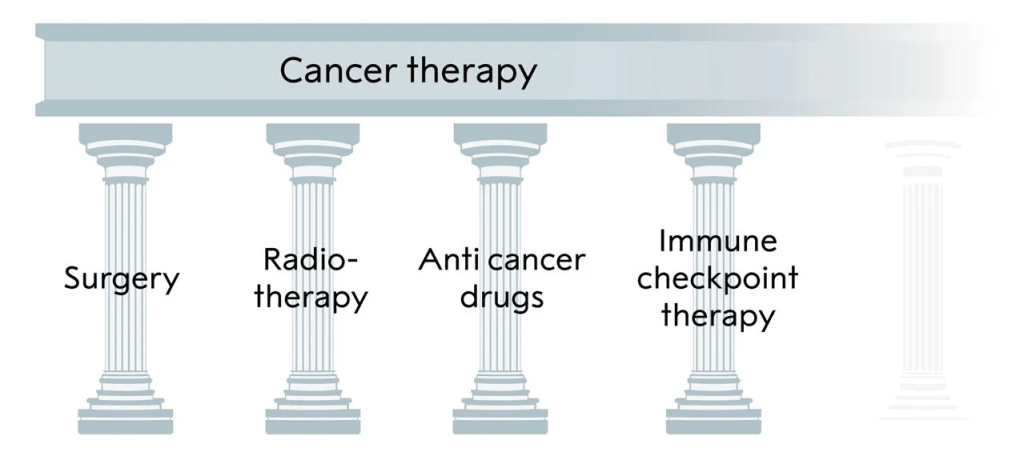
The three pillars of cancer treatment, all directed against the cancer cell, and the fourth, immune checkpoint inhibitor, based on unleashing an immune response against the tumor.
Immense progress has been made in mechanistic understanding of tumor-intrinsic factors that drive cancer progression; however, therapeutic targeting of these factors is often associated with therapy resistance and cancer recurrence. On the contrary, therapies that target tumor-extrinsic factors, such as immunotherapy, generate robust and durable responses in patients across various types of cancer and have emerged as the fourth pillar of cancer treatment. However, current immunotherapies are ineffective in approximately 50% of tumors, particularly immune-cold tumors. This underscores either the inefficacy of existing immunotherapeutic strategies or a lack of understanding regarding tumor-extrinsic factors in these types of tumors, or both. Addressing these knowledge gaps, I believe, can significantly enhance patient survival and reduce cancer mortality, and that is the grounding mission of my research program.
Major Research Areas
Intercellular crosstalk in cancer
How coding and non-coding genome modulates the intrinsic biology of a cell has been extensively studied, however, its role in modulating a cell’s crosstalk with other cell types is a frontier that remains significantly understudied. Here, by using physiologically-relevant in vitro and in vivo models, including humanized mice, leveraging cutting-edge genome modulation and single-cell omics approaches that preserve the spatiotemporal information of the intercellular crosstalk, cell and molecular biology, immunology, and extracellular vesicle biology, I aim to develop a comprehensive understanding of the genetic basis of cell-to-cell communication in cancer. My ongoing research in cancer-to-T cell crosstalk has revealed novel yet clinically relevant mechanism of EV-mediated T cell suppression in immune-cold tumors. Additionally, I have pinpointed strategies to overcome immunosuppression in immune-cold tumors, thereby enhancing the effectiveness of immunotherapies in this class of challenging-to-treat tumors. As my research expands to include the study of crosstalk between cancer cells and other cell types, along with its genetic and epigenetic regulation, it inherently fosters collaboration with experts in immunology, neurobiology, endocrinology, systems biology, and other related fields. In summary, this research is poised to be the cornerstone of future projects, pushing the boundaries of our understanding and treatment of cancer.
Targeted RNA therapeutics
As a building block for coding and non-coding genome functions, RNA-based therapeutics can theoretically target any coding and non-coding RNA of interest. By contrast, only 0.05% of the human genome has been drugged by the currently approved protein-targeted therapeutics (small-molecule chemicals and antibodies). Historically, RNA-based therapeutics have faced delivery and stability challenges, including vehicle-associated toxicity and endosomal entrapment. My prior experience in microRNA-based targeted cancer therapy has tackled these challenges in a significant manner. We designed a first-in-class chemically modified anti-tumor miRNA (miR-34a) with >400-fold increased stability, developed a ligand-mediated vehicle-free approach for targeted delivery of modified miR-34a to tumors in vivo, leading to reduced dosing yet sustained anti-tumor effect, and included additional moieties in the therapeutic design to promote endosomal escape. While mRNA-based immunotherapies are currently under investigation, utilization of microRNAs or siRNAs as immunotherapeutics remains underexplored. This research area will utilize synthetic RNA biology, patient-derived xenograft models, and clinical studies in collaboration with physician scientists to develop a novel class of miRNA/siRNA-based immunotherapies or enhance existing immunotherapies in immune-cold tumors.
Grants awarded
Department of Defense W81XWH-21-1-0181 (2021-2023)
PI – Sohal
Title – “Ligand-targeted miRNA delivery for prostate cancer therapy”
Description – The overall goal of the project is to develop a safe, efficient, and targeted approach to deliver tumor suppressive microRNAs (miRNAs) to prostate cancer by addressing two major clinical challenges associated with miRNA delivery: (i) vehicle-associated toxicity and (ii) poor in vivo stability of miRNA.
Indiana Clinical and Translational Sciences Institute 23111758 (2023-2024)
PI – Sohal
Title – “Classification of human lung tumor specimens based on immune contexture”
Description – The proposal aims to classify human lung tumor specimens into immune-hot, intermediate, and immune-cold categories based on their T-cell infiltration status and Immunoscore quantification.
Preprint publications
†First author, *Corresponding author
- Sohal IS*, Pal AK, Lepine J, Liu P, Wisnewski AV, Redlich CA, Bello D*. “A cross-week analysis of urinary extracellular vesicles after respiratory tract exposure intervention identifies systemic signaling changes – a pilot study of isocyanate-exposed workers.” bioRxiv (2025). https://doi.org/10.1101/2025.02.21.639517
Peer-reviewed publications
†First author, *Corresponding author
- Abdelaal AM, Sohal IS*, Iyer SG, Sudarshan K, Orellana EA, Ozcan K, Santos AP, Low P, and Kasinski AL*. “Selective targeting of chemically modified miR-34a to prostate cancer using a small molecule ligand and an endosomal escape agent.” Molecular Therapy – Nucleic Acids (2024). https://doi.org/10.1016/j.omtn.2024.102193
- Abdelaal A, Sohal IS*, Iyer S, Kasireddy S, Lanman N, Kothandaraman H, Low P, and Kasinski A*. “A first-in-class fully modified version of miR-34a with outstanding stability, activity, and anti-tumor efficacy.” Oncogene (2023). https://doi.org/10.1038/s41388-023-02801-8
- Sohal IS, Kasinski, A*. “Emerging diversity in extracellular vesicles and their roles in cancer”. Frontiers in Oncology (2023). https://doi.org/10.3389/fonc.2023.1167717
- Dar MS, Mensah IK, He M, McGovern S, Sohal IS, Whitlock HC, Bippus NE, Ceminsky M, Emerson ML, Tan HJ, Hall MC, Gowher H*. “Dnmt3bas coordinates transcriptional induction and alternative exon inclusion to promote catalytically active Dnmt3b expression.” Cell Reports (2023). https://doi.org/10.1016/j.celrep.2023.112587
- Kaur J†, Sohal IS†, Singh H, Gupta NK, Sehrawat S, Puri S, Bello D*, Khatri M*. “Toxicity screening and ranking of diverse engineered nanomaterials using hierarchical testing approaches with an in vivo zebrafish model.” Environmental Science: Nano (2022). https://doi.org/10.1039/D2EN00265E
- Hasan H†, Sohal IS†, Soto-Vargas Z†, Byappanahalli, AM, Humphrey SE, Kubo H, Kitdumrongthum S, Copeland S, Tian F, Chairoungdua A, Kasinski AL*. “Extracellular vesicles released by non-small cell lung cancer cells drive invasion and permeability in non-tumorigenic lung epithelial cells.” Scientific Reports (2022). https://doi.org/10.1038/s41598-022-04940-6
- Pal AS†, Agredo A†, Lanman NA, Son J, Sohal IS, Bains M, Li C, Clingerman J, Gates K, Kasinski AL*. “Loss of KMT5C Promotes EGFR Inhibitor Resistance in NSCLC via LINC01510-Mediated Upregulation of MET.” Cancer Research (2022). https://doi.org/10.1158/0008-5472.CAN-20-0821
- Sohal IS†, DeLoid GM†, O’Fallon KS, Gaines P, Demokritou P*, Bello D*. “Effects of ingested food-grade titanium dioxide, silicon dioxide, iron (III) oxide and zinc oxide nanoparticles on an in vitro model of intestinal epithelium: Comparison between monoculture vs. a mucus-secreting coculture model.” NanoImpact (2020). https://doi.org/10.1016/j.impact.2020.100209
- Liu X, Zhang B, Sohal IS, Bello D, Chen H. “Is,“nano safe to eat or not”? a review of the state-of-the art in soft engineered nanoparticle (sENP) formulation and delivery in foods.” Advances in Food and Nutrition Research (2019). https://doi.org/10.1016/bs.afnr.2019.03.004
- Sohal IS*, O’Fallon KS, Gaines P, Demokritou P, Bello D*. “Ingested engineered nanomaterials: state of science in nanotoxicity testing and future research needs.” Particle and Fibre Toxicology (2018). https://doi.org/10.1186/s12989-018-0265-1
- Sohal IS*, Cho YK, O’Fallon KS, Gaines P, Demokritou P, Bello D*. “Dissolution Behavior and Biodurability of Ingested Engineered Nanomaterials in the Gastrointestinal Environment.” ACS Nano (2018). https://doi.org/10.1021/acsnano.8b02978
- DeLoid GM†, Sohal IS, Lorente LR, Molina RM, Pyrgiotakis G, Stevanovic A, Zhang R, McClements DJ, Geitner NK, Bousfield DW, Ng KW, Loo SCJ, Bell DC, Brain J, Demokritou P*. “Reducing Intestinal Digestion and Absorption of Fat Using a Nature-Derived Biopolymer: Interference of Triglyceride Hydrolysis by Nanocellulose.” ACS Nano (2018). https://doi.org/10.1021/acsnano.8b03074
- Lee S†, Sohal IS, Therrien MA, Pal AK, Bello D, Shea TB*. “Additive impairment of synaptic signaling in cultured cortical neurons by exogenously-applied oligomerized amyloid-β and airborne nanoparticles generated during photocopying.” Journal of Alzheimer’s Disease (2015). https://doi.org/10.3233/jad-150099
 Ikjot Singh Sohal